
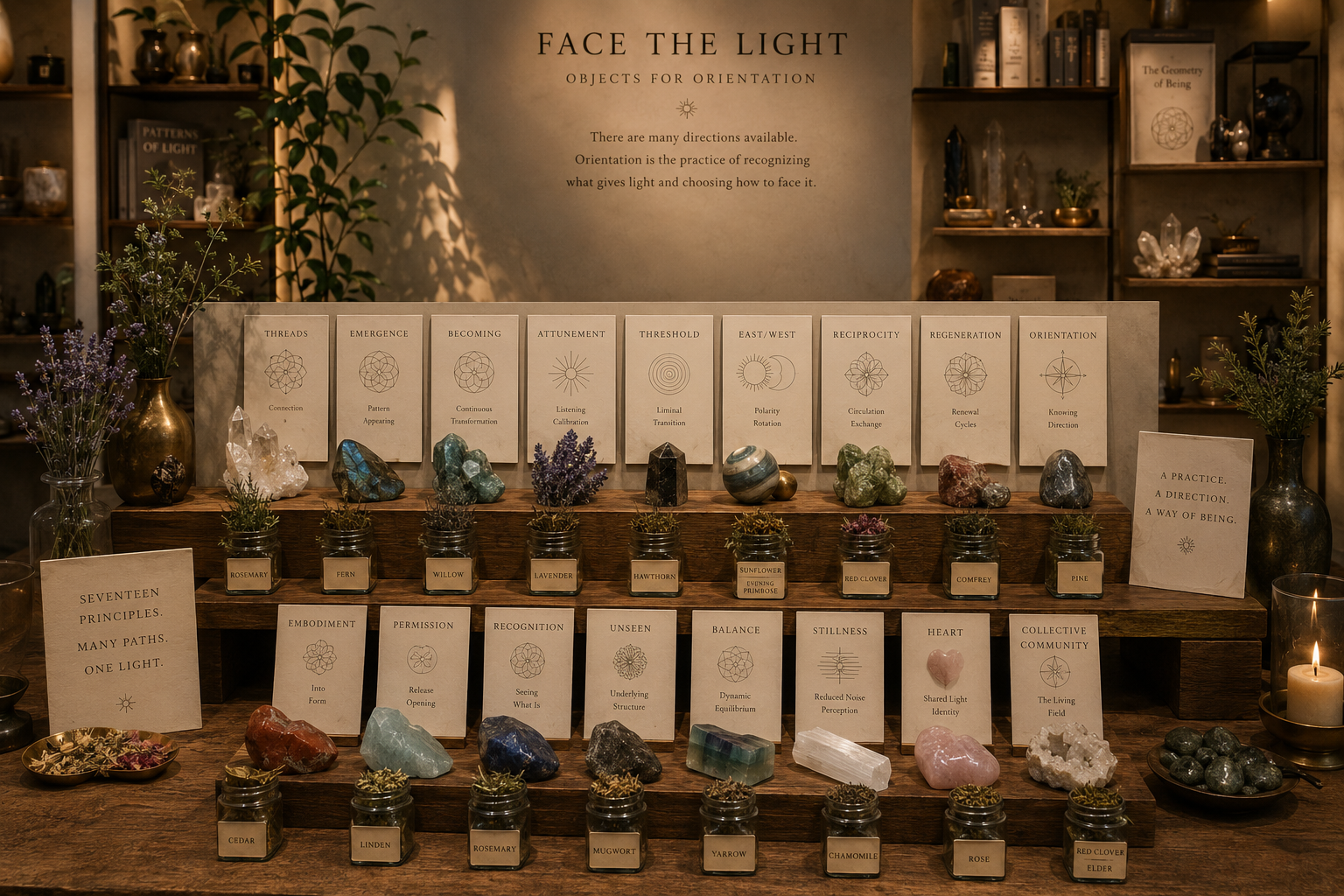
The seventeen principles of Hymns of Light—Threads, Emergence, Becoming, Attunement, Threshold, East/West, Reciprocity, Regeneration, Orientation, Embodiment, Permission, Recognition, Unseen, Balance, Stillness, Heart, and Collective/Community—describe different ways of entering into relationship with a living field. Together, they move from the first recognition of connection toward a deeper awareness of pattern, exchange, embodiment, perception, and collective coherence. The table below translates these principles into a material vocabulary of crystals and herbs. Rather than treating these materials as ingredients for prescribed outcomes, the correspondences position them as tools of orientation: physical forms through which a principle can be contemplated, remembered, and practiced. A crystal’s structure, an herb’s growth pattern, or a plant’s ecological behavior can become another way of encountering the same relationships described throughout the Hymns.
| Hymn / Principle | Crystal family | Herb / botanical family | Why it belongs |
|---|---|---|---|
| 1. Threads — Connection | Rutilated Quartz · Clear Quartz · Moss Agate | Rosemary · Mycelial/mushroom imagery · Ivy | Rutilated quartz literally contains visible internal “threads.” Rosemary carries remembrance and continuity; ivy expresses linkage and interdependence. Threads begins with connection existing before structure, with individual pathways becoming a weave. |
| 2. Emergence — Pattern Appearing | Labradorite · Rainbow Moonstone · Clear Quartz | Fern · Mugwort · Sprouting seeds | Labradorite reveals flashes only as orientation changes—an excellent material analogue for latent pattern becoming perceptible. Ferns unfurl from compressed form. Emergence is distributed activity gradually resolving into recognizable organization. |
| 3. Becoming — Continuous Transformation | Malachite · Chrysocolla · Fluorite | Horsetail · Willow · Bamboo | Malachite’s layered banding visually records growth and transformation. Willow bends rather than breaks; bamboo is continual growth through articulated stages. Becoming is explicitly not a final state, but ongoing adaptive transformation. |
| 4. Attunement — Listening / Calibration | Blue Lace Agate · Celestite · Aquamarine | Lavender · Lemon Balm · Tulsi | These are quieting rather than amplifying materials. Lavender and lemon balm suit the principle of reducing noise so subtle distinctions can be perceived. Attunement works through listening, responsiveness and small relational adjustments rather than force. |
| 5. Threshold — Liminal Transition | Labradorite · Black Moonstone · Smoky Quartz | Bay Laurel · Yarrow · Hawthorn | Labradorite is almost archetypally liminal; smoky quartz gives grounding while crossing. Hawthorn has long folkloric associations with boundaries and thresholds. The hymn describes the condition of being not left, not arrived, waiting for sufficient readiness to cross. |
| 6. East / West — Polarity & Rotation | Sunstone + Moonstone as a pair · Citrine + Smoky Quartz | Sunflower + Jasmine· Calendula + Evening Primrose | This one should be represented by paired materials, not a single object. Sunrise/sunset, expansion/return and complementary phases are the point. East/West treats apparent opposites as phase positions within one continuous field rather than antagonists. |
| 7. Reciprocity — Circulation / Exchange | Green Aventurine · Rhodonite · Ocean Jasper | Nettle · Red Clover · Mint | Aventurine and rhodonite suit open exchange; ocean jasper’s repeating circular structure is particularly good visually. Clover and nettle participate strongly in ecological cycles of soil and nutrient exchange. Reciprocity is the circulatory system of the framework: giving and receiving as one continuous movement. |
| 8. Regeneration — Renewal Through Cycles | Moss Agate · Bloodstone · Malachite | Comfrey · Calendula · Nettle | Moss agate visually evokes growth returning through stone. Comfrey and calendula carry strong traditional associations with restoration; nettle thrives in disturbed ground. Regeneration is not erasure or restart, but existing material reorganized into new life. |
| 9. Orientation — Knowing Where You Face | Lodestone / Magnetite · Tiger’s Eye · Clear Quartz | Rosemary · Pine · Sage | Magnetite is the strongest conceptual correspondence in the whole collection. It literally orients to a field. Tiger’s eye combines observation with grounded position. Rosemary and pine carry memory, location and steadiness. Orientation in the Hymns is not map-following but relational positioning: knowing where you stand in relation to the light. |
| 10. Embodiment — Pattern Becoming Form | Red Jasper · Hematite · Garnet | Ginger · Cedar · Oak | Dense, materially grounded stones belong here. Jasper and hematite bring the principle downward into weight, body and physical presence. Cedar/oak signify durable structure; ginger suggests animation within the body. Embodiment is where coherence ceases being conceptual and becomes enacted form. |
| 11. Permission — Release / Opening | Aquamarine · Amazonite · Green Calcite | Lemon Balm · Linden · Violet | These should feel soft rather than forceful. Permission is about stopping constriction, not acquiring power. Linden, violet and lemon balm fit the gesture of relaxing, opening and allowing movement already ready to occur. |
| 12. Recognition — Seeing What Was Already There | Lapis Lazuli · Sodalite · Clear Quartz | Eyebright · Rosemary · Sage | Lapis and sodalite correspond well to perception, discernment and pattern recognition. Rosemary adds remembrance—important because Recognition repeatedly functions as remembering rather than discovering. The Hymn describes the system becoming able to perceive its pre-existing coherence. |
| 13. Unseen — Underlying Structure | Obsidian · Black Tourmaline · Phantom Quartz | Mugwort · Myrrh · Fern root / woodland botanicals | Phantom quartz is exceptionally appropriate: earlier growth stages remain visibly nested inside the crystal. Mugwort carries longstanding associations with unseen perception. The Unseen is the hidden infrastructural layer—trust, relational networks, ecological systems—that supports the visible weave. |
| 14. Balance — Proportion / Dynamic Equilibrium | Fluorite · Zebra Jasper · Tourmalinated Quartz | Tulsi · Chamomile · Yarrow | Fluorite’s ordered geometry works especially well because Balance is not bland neutrality; it is continuous proportional adjustment. Zebra jasper and tourmalinated quartz visibly hold contrasting components in one body. Yarrow works as an edge/boundary regulator. |
| 15. Stillness — Reduced Noise / Perception | Selenite · Howlite · Amethyst | Lavender · Chamomile · Blue Lotus | Selenite gives you almost the perfect physical language: quiet, luminous, minimal. Lavender/chamomile reinforce settling and receptive awareness. Stillness in the Hymns isn’t inactivity—it reduces interference so pattern can become perceptible and recalibration can occur. |
| 16. Heart — Shared Light / Underlying Identity | Rose Quartz · Rhodonite · Green Aventurine | Rose · Hawthorn · Hibiscus | Rose quartz is obvious but actually justified here. Rhodonite is useful if you want the line to feel less cliché. Rose and hawthorn give the principle botanical depth. Heart is the shared underlying field expressed through many forms—the point at which interdependence becomes identity. |
| 17. Collective / Community — The Living Field | Crystal Cluster rather than one crystal · Apophyllite cluster · Amethyst cluster | Red Clover · Elder · Mycelium/mushrooms · mixed meadow herbs | This should deliberately break the one-object convention. A cluster is the crystal. A polyculture is the herb. The final hymn gathers all the prior dynamics into one functioning field; the manuscript explicitly describes threads joining, one light in every chest, and humanity standing as the visible living field. |
Seen this way, the table is less a catalogue of metaphysical properties than a material map of the seventeen Hymns. Magnetite does not simply “mean” Orientation; its responsiveness to a field demonstrates something about orientation itself. A crystal cluster gives physical form to Collective/Community, while a fern unfurling offers a botanical image of Emergence. Each correspondence creates a bridge between an abstract principle and something that can be held, observed, grown, smelled, or encountered in space. The purpose is not to ask what a particular crystal or herb can do for us, but to ask what relationship it can help us notice. Through that shift, the materials become companions to the Hymns: small points of contact through which the larger language of connection, attunement, reciprocity, regeneration, and shared light can enter everyday experience.